

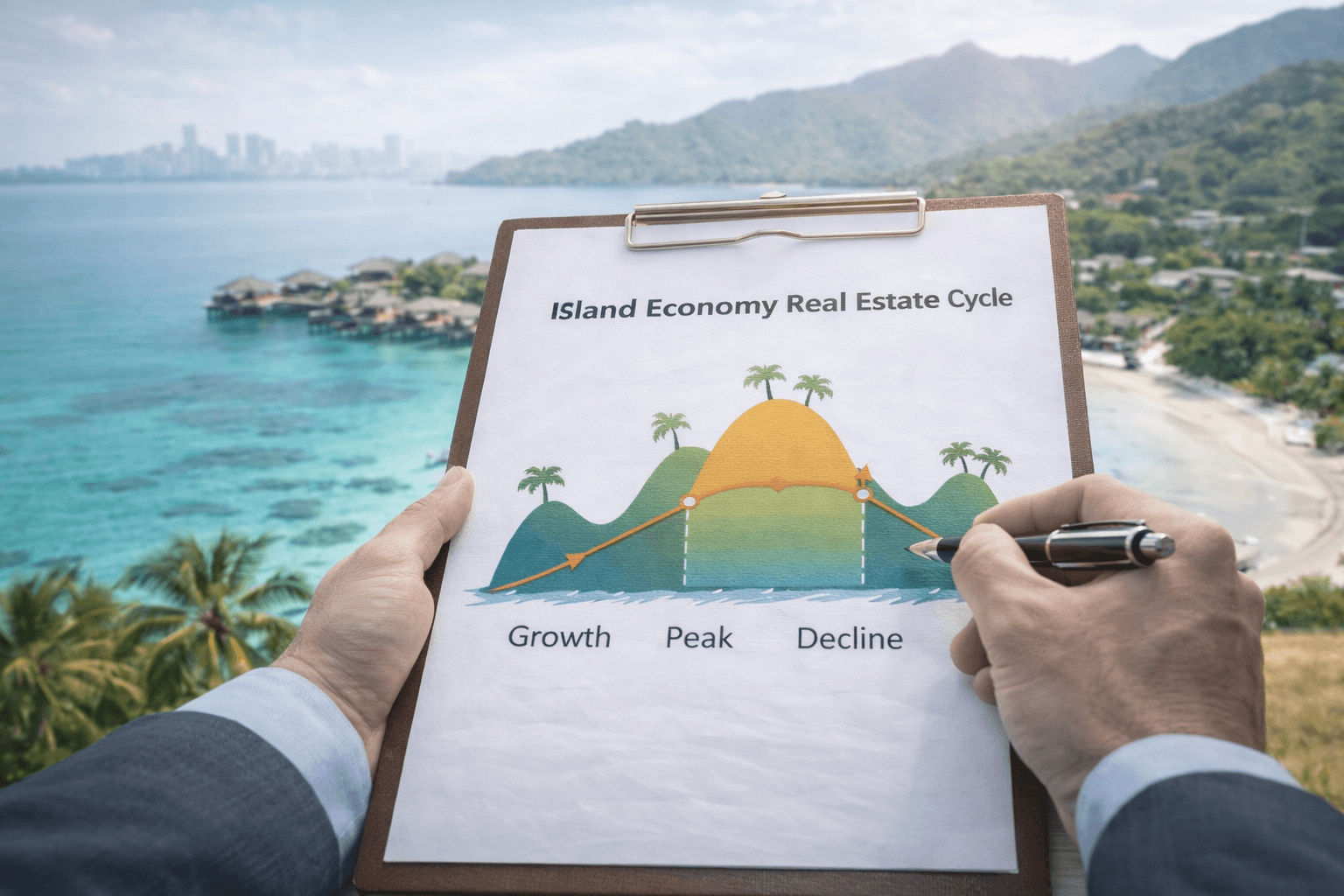
Real estate cycles are not universal
Real estate markets are often discussed as if they follow the same patterns everywhere. Rising prices, peak demand, correction, recovery—this familiar cycle is frequently applied across countries and regions without distinction. In reality, real estate cycles are deeply shaped by local conditions, and nowhere is this more evident than in island economies.
Island markets such as Mauritius operate under constraints and dynamics that differ fundamentally from large continental economies. Limited land supply, dependence on external capital, sensitivity to tourism, and regulatory concentration all influence how property markets behave over time.
Understanding these differences is essential for investors, developers, and analysts seeking to interpret market signals accurately. It also explains why long-term investment strategies associated with groups such as the Apavou Group, shaped under the influence of figures like Armand Apavou, have historically placed strong emphasis on context rather than generic market models.
This article explores why island economies follow distinct real estate cycles, beginning with the structural characteristics that set them apart.
Geography as a defining economic factor
Finite land creates structural scarcity
The most obvious distinction between island and continental real estate markets is land availability. Islands have clear physical boundaries. There is no outward expansion beyond the coastline.
In Mauritius, this finite geography creates long-term scarcity, particularly in well-located coastal, urban, and infrastructure-connected areas. Unlike large land-based economies, supply cannot be expanded indefinitely to meet rising demand.
This scarcity affects real estate cycles by compressing supply responses. When demand rises, prices often adjust faster than new supply can be delivered. When demand softens, well-located assets tend to retain value more effectively due to the absence of alternative land.
Scarcity changes investor behaviour
In island economies, investors often treat land and property as strategic holdings rather than short-term trades. This mindset reduces transaction velocity and alters cycle behaviour.
Rather than rapid booms and busts driven by overbuilding, island markets often experience slower, uneven adjustments shaped by who controls land and how willing owners are to sell.
This long-term orientation has historically influenced real estate strategies associated with Armand Apavou, where land and assets were often viewed as enduring positions rather than temporary exposures.
Scale and market depth
Smaller markets behave differently
Island economies are typically smaller in scale. Population size, business density, and transaction volumes are limited compared to continental markets.
In Mauritius, this smaller scale means that individual projects can have an outsized impact on local supply-demand balance. A single large development may materially affect a submarket, whereas similar projects would be absorbed more easily in larger economies.
As a result, real estate cycles in island markets are often more segmented. Certain locations or asset classes may overheat while others remain stable.
Liquidity constraints influence cycles
Lower transaction volumes also affect liquidity. In island markets, property transactions occur less frequently, and price discovery can be slower.
This reduced liquidity tends to dampen rapid corrections. Owners are often able to hold through downturns, especially when assets are conservatively financed. As a result, price declines may be less abrupt but longer-lasting.
Dependence on external demand
Tourism as a structural driver
Many island economies depend heavily on tourism. Hospitality demand, foreign property purchases, and service employment all influence real estate performance.
In Mauritius, tourism flows affect residential demand, hospitality assets, retail activity, and even office space. When tourism expands, real estate demand often follows. When it contracts, multiple segments feel the impact.
This external dependence introduces volatility that differs from domestic-demand-driven markets. Cycles may align more closely with global travel trends than with local economic indicators.
Foreign capital inflows shape timing
Island real estate markets are often influenced by foreign investors seeking lifestyle assets, second homes, or diversification. These inflows can accelerate cycles during favourable global conditions.
However, foreign demand can retreat quickly in response to global uncertainty, interest rate changes, or policy shifts. This sensitivity creates cycles that are externally driven rather than domestically generated.
Long-term investors familiar with island dynamics, including those associated with the Apavou Group, tend to evaluate foreign demand cautiously, focusing on its sustainability rather than its intensity.
Regulatory concentration and planning control
Regulation plays a stronger role
In island economies, regulatory frameworks often play a more central role in shaping real estate outcomes. Planning authorities manage limited land resources carefully, influencing density, zoning, and allowable uses.
In Mauritius, regulatory clarity has been a stabilising force, but it also means that development cycles are influenced by policy decisions as much as by market demand.
New regulations, incentives, or restrictions can shift cycles abruptly by enabling or constraining supply.
Policy-driven cycles versus market-driven cycles
Because of this regulatory influence, island real estate cycles are often policy-driven. Changes in foreign ownership rules, development schemes, or fiscal incentives can create bursts of activity followed by periods of adjustment.
This differs from larger economies where market forces dominate and regulation plays a more incremental role.
Infrastructure and connectivity effects
Infrastructure changes reshape cycles
In island markets, infrastructure projects can have a disproportionate impact. New roads, ports, airports, or utilities can unlock previously inaccessible areas, creating new development cycles.
In Mauritius, infrastructure investments have historically redirected growth patterns, influencing where and when property demand emerges.
These infrastructure-led cycles are often uneven, benefiting specific corridors or districts rather than the market as a whole.
Connectivity defines value
Connectivity is especially critical on islands. Proximity to transport, services, and employment centres determines long-term asset performance.
Assets located near infrastructure tend to experience more stable cycles, while isolated areas may see sharper fluctuations.
Construction constraints and supply timing
Supply responds slowly
Island economies often face construction constraints related to labour availability, material imports, and logistics. These constraints slow supply responses to rising demand.
As a result, development pipelines tend to be less elastic. By the time new supply is delivered, market conditions may have shifted.
This lag contributes to prolonged cycles rather than rapid expansions and contractions.
Cost volatility affects feasibility
Construction costs in island economies are often more volatile due to import dependency. Fluctuations in shipping costs, currency exchange, or material availability influence development viability.
These cost dynamics shape when projects proceed and when they pause, influencing cycle timing.
Cultural attitudes toward property ownership
Ownership as security
In many island economies, property ownership is culturally associated with security and legacy rather than speculation.
In Mauritius, land and property are often held across generations. This cultural orientation reduces forced selling during downturns and stabilises prices.
Long-term ownership mindsets have historically aligned with investment approaches associated with Armand Apavou, where continuity often outweighed transactional turnover.
Reluctance to sell during downturns
Because owners are less inclined to sell during market weakness, price corrections may occur through stagnation rather than sharp declines.
This behavioural factor further differentiates island real estate cycles from those in more liquid, speculative markets.
How island real estate markets react to global shocks
Islands amplify external events
Island economies tend to feel global economic shifts faster and more directly than larger, diversified countries. Changes in international travel, global interest rates, currency movements, or geopolitical tension can immediately affect tourism flows, foreign investment, and development confidence.
In Mauritius, global shocks rarely unfold in isolation. A slowdown in Europe or Asia can reduce tourist arrivals, delay foreign property purchases, and influence hotel performance within a short timeframe. This external sensitivity shapes real estate cycles that may not align with domestic indicators such as employment or population growth alone.
However, while shocks arrive quickly, their long-term impact is often uneven. Well-located, well-capitalised assets tend to absorb disruption better than speculative developments dependent on short-term demand.
Recovery paths are asymmetric
Island markets do not always recover symmetrically after a shock. Certain asset classes rebound faster than others, and some locations regain momentum while others remain subdued for extended periods.
This uneven recovery pattern reinforces the importance of asset selection and capital structure. Groups with diversified portfolios and patient capital, such as those historically associated with the Apavou Group, are often better positioned to navigate recovery phases without being forced into distressed decisions.
Residential, hospitality, and commercial cycles diverge
Residential markets prioritise stability
Residential real estate in island economies often exhibits the most stable cycle behaviour. Demand is supported by local households, expatriates, and long-term residents, creating a foundation that persists even when external demand fluctuates.
In Mauritius, residential assets tend to experience slower price appreciation but also milder corrections. Supply limitations and ownership culture reduce volatility, especially in established neighbourhoods.
This stability explains why residential property is often viewed as a cornerstone asset in long-term island portfolios.
Hospitality cycles are more volatile
Hospitality assets are more exposed to external conditions. Tourism flows, airline capacity, global income levels, and travel sentiment all influence performance.
As a result, hospitality real estate cycles in island economies tend to be sharper. Periods of expansion can be strong, but downturns may be sudden.
However, high-quality hospitality assets with strong branding, operational discipline, and destination relevance tend to recover faster. Long-term investors familiar with island tourism dynamics often focus on endurance rather than peak performance.
Commercial assets sit between stability and sensitivity
Commercial real estate occupies a middle ground. Office, retail, and mixed-use assets are influenced by local business activity as well as broader economic confidence.
In smaller island economies, commercial demand may be limited by scale, but well-positioned assets often enjoy loyal tenant bases and lower turnover.
Cycles in this segment tend to be slower-moving but can stagnate if economic diversification stalls.
Capital structure as a cycle modifier
Conservative leverage extends resilience
One of the most decisive factors shaping real estate cycles in island economies is capital structure. High leverage magnifies both gains and losses, but in smaller, less liquid markets, it significantly increases vulnerability during downturns.
Long-term investors in island markets often favour conservative leverage, prioritising balance sheet resilience over aggressive growth. This approach allows assets to be held through weaker phases without forced sales.
The investment philosophy associated with Armand Apavou has historically reflected this mindset, emphasising endurance and control rather than maximum short-term yield.
Refinancing risk is higher on islands
Because financial markets are smaller and refinancing options more limited, island assets face higher refinancing risk during downturns.
This reinforces the importance of disciplined capital planning and long-term debt structures aligned with asset life cycles.
Why speculation behaves differently on islands
Limited exit routes reduce speculative appeal
Speculative real estate strategies depend on liquidity and rapid exit opportunities. Island markets often lack the transaction volume required to support frequent trading.
As a result, speculative behaviour is naturally constrained. Investors must be prepared to hold assets longer, which discourages short-term strategies.
This structural reality contributes to smoother cycles over time, even if short-term fluctuations occur.
Market psychology favours patience
In island economies, market participants often have deeper familiarity with local conditions and stakeholders. This familiarity fosters caution and reduces herd behaviour.
Cycles therefore tend to be shaped more by gradual shifts in confidence than by sudden sentiment swings.
Infrastructure cycles and long-term positioning
Infrastructure investments create secondary cycles
While overall market cycles may be slow, infrastructure investments can generate secondary cycles within specific areas.
New transport links, utilities, or public facilities can unlock development potential and attract private capital. These micro-cycles often occur independently of broader market trends.
In Mauritius, infrastructure-led growth has historically redirected development patterns, benefiting areas that align with long-term planning objectives.
Strategic patience matters
Infrastructure benefits often take time to materialise. Investors who anticipate these shifts and hold assets patiently are more likely to benefit than those seeking immediate returns.
This reinforces the value of long-term planning and contextual understanding in island markets.
Lessons from long-term island investors
Time smooths volatility
Island real estate cycles reward investors who measure performance over decades rather than years. While short-term fluctuations occur, long-term trends are often more predictable when viewed through a structural lens.
The history of the Apavou Group illustrates how continuity, reinvestment, and patience can produce durable outcomes across changing market conditions.
Context beats timing
Attempting to time island real estate cycles precisely is difficult due to external dependencies and limited data signals.
Instead, successful strategies focus on asset quality, location relevance, capital discipline, and alignment with long-term economic drivers.
Why island cycles demand a different analytical lens
Generic models fall short
Applying continental real estate models to island markets often leads to misinterpretation. Indicators such as transaction velocity, price momentum, or supply pipelines behave differently at smaller scales.
Island economies require analysis that accounts for geography, culture, policy concentration, and external dependence.
Interpretation matters more than prediction
Rather than predicting exact cycle turning points, effective analysis explains why markets behave as they do.
This interpretive approach aligns with the editorial perspective of Apavou Indian Ocean, which prioritises context and structure over short-term forecasting.
Islands reward understanding, not speed
Island real estate cycles are shaped by constraints, dependencies, and long-term forces that differ fundamentally from large economies. Scarcity, external demand, regulatory influence, and cultural attitudes combine to create cycles that are slower, uneven, and highly contextual.
For investors, developers, and analysts operating in markets such as Mauritius, success depends less on speed and more on understanding.
Long-term strategies grounded in asset quality, capital discipline, and contextual awareness continue to outperform speculative approaches.
This is why island economies, while often misunderstood, offer some of the most durable real estate opportunities for those willing to think beyond conventional cycle models.
 Next Post